


Exactly two weeks ago, I argued that the worst bear market for bonds since the 1970s was due for at least a tactical reprieve because investors were overestimating the number of Federal Reserve rate hikes likely in the year or so ahead. By sheer good luck, the US bond market turned on that very day. The 10-year yield peaked on October 6 at 5.31%, and declined to 5.09% by last Friday in response to a series of Fed comments that proved less hawkish than expected, before rebounding slightly on Monday.
Better still for the view that bond prices these days are driven almost exclusively by Fed expectations, the past fortnight’s bond market rebound has occurred in a clearly deteriorating inflation environment, as evidenced by the shockingly bad US CPI and PPI data released last Wednesday. Meanwhile, the near-perfect correlation between US bond yields and expectations of Fed policy highlighted here two weeks ago has continued with remarkable exactitude in the daily market movements of both nominal and real 10-year yields. The Fed funds futures even anticipated Monday’s slight uptick in bond yields by a few trading days, in a pattern even more firmly established in the nine months since Kevin Warsh was nominated as Fed Chairman on January 31.
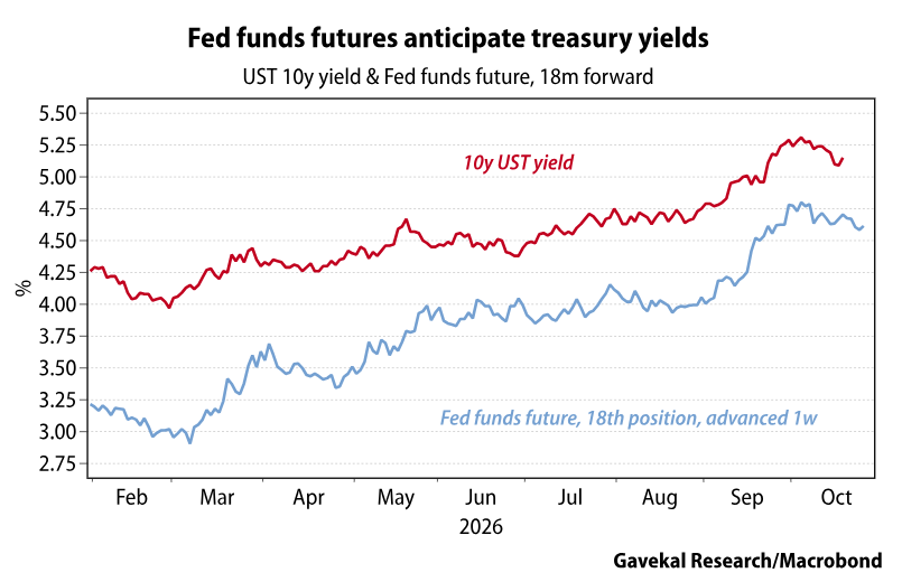
This tight correlation between bonds and Fed expectations will break down sooner or later, but for the moment the direction of long-term yields seems totally determined by whether investors decide that the Fed plans to tighten more or less than the markets have priced in.
Why has the bond market become a slave to Fed expectations? Two reasons that I have discussed with clients for years are especially relevant today.
The first is that many bond investors are so confident about the Fed’s ability and willingness to hit its inflation target that they dismiss short-term fluctuations in data on inflation, fiscal policy, GDP and so on as irrelevant noise. Economists trained at leading US and European universities almost unanimously believe that central banks can bring inflation to whatever level they deem appropriate and keep it there—and that they can do this at minimal economic cost, provided inflationary expectations are “anchored” on the central bank’s target.
The chart below, based on the Survey of Professional Forecasters conducted quarterly by the Philadelphia Fed reveals the quasi-religious faith of conventional economists, and thus of the bond institutions that employ them, in the inflation-fighting ability of central banks.
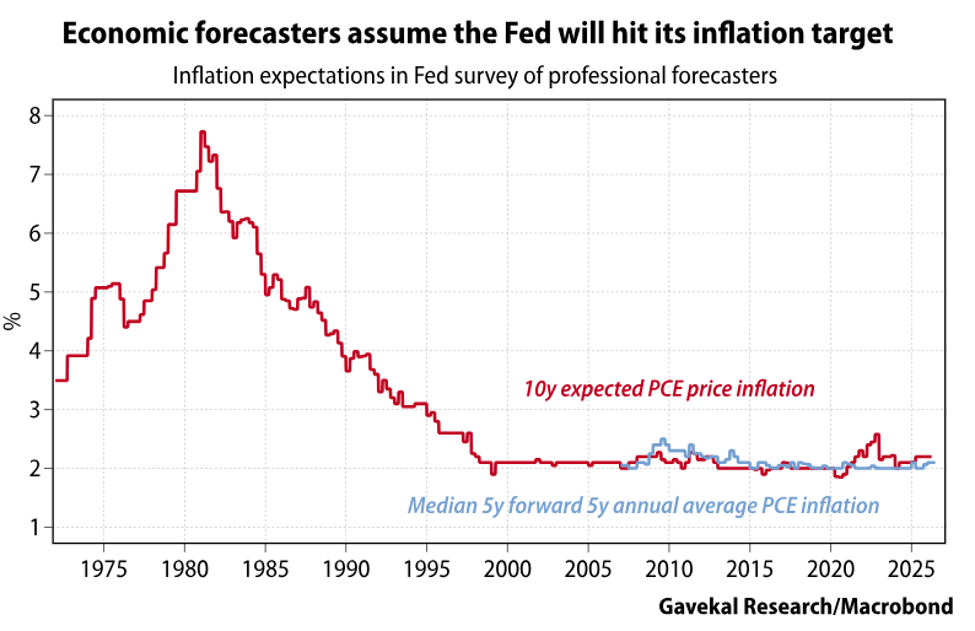
Since the start of the 21st century, these economic oracles have always predicted, regardless of wars, epidemics, energy shocks, fiscal blowouts and financial crises, that inflation would converge exactly onto the Fed’s 2% target (since 2% PCE has historically been equivalent to 2.4% CPI). And they have always stuck to this same prediction since 2022 despite five consecutive years of failure by central banks to get inflation anywhere near their targets. They have done this partly because inflation that converges to whatever is the central bank target is an assumption, built into the so-called “rational expectations” structure of economic models used by almost all financial institutions and central banks.
A second reason for the iron grip of short-term policy expectations on long-term bond yields is the changing structure of the bond market. Bond prices today are not determined, as taught in economics textbooks, by an interplay of government borrowers with buy-and-hold investors trying to maximize their long-term real purchasing power. Instead, bond trading today is dominated by hedge funds, algos and other short-term trend-followers for whom forecasts of inflation, or GDP or fiscal conditions 10 years ahead, or even one year ahead, are entirely irrelevant except insofar as they may influence the Fed’s decisions on short-term policy rates.
Moreover, even among the minority of long-term investors, there is much less sensitivity than generally assumed to economic and fiscal fundamentals, because the largest long-term bondholders are not trying to maximize their profits, nor even to preserve their purchasing power. Instead, they have non-financial motivations: regulation in the case of pension and insurance funds; geopolitics or trade policy, in the case of international reserve managers; macroeconomic management, in the case of the Fed itself oscillating between quantitative easing and quantitative tightening.
This leaves only a small residual of profit-oriented long-term bond investors who genuinely care about what may happen to inflation, fiscal policy or economic growth more than a year or two ahead. This means that long-term forecasting of economic and fiscal fundamentals has become almost irrelevant to bond investment, whereas predicting short-term changes in policy rates has become paramount.
Combining the professional economists’ faith in Fed inflation targets with the bond traders’ obsession with Fed policy moves results in a market that slavishly follows expectations of Fed policy and is largely insensitive to inflation data, as evidenced by the decline in bond yields last week.
If this analysis is correct, the direction of bond yields will be set by whether the Fed rhetoric continues to sound less hawkish, as it has in the past two weeks, or turns more aggressive again, as it did in September. That, in turn, will depend mainly on what happens to the AI investment boom and the US equity bull market, which now depends entirely on the profits generated by AI investment, either directly or indirectly via the Kalecki-Levy profits equation, as explained here in August.
If the AI bubble shows signs of deflating, perhaps due to financing problems, the Fed will probably become more dovish, and further gains in bonds will be almost guaranteed. If, on the other hand, the AI investment boom continues and Wall Street gains accelerate, the Fed may return to its earlier hawkish rhetoric, in which case bond yields could retest their recent highs but are unlikely to go much higher because long rates approaching 5.5% will again challenge the boom in US investment.
Either way, bonds have returned, at least for the time being, to their traditional inverse correlation with equities. As a result, bonds can again play a useful role, for the first time since 2022, as a hedge against equity losses in balanced portfolios.
This period of useful hedging will come to an end when one of two things happen. The Fed could decide to hike short rates very aggressively in a genuine effort to squeeze inflation down to 2%, in which case bond yields will inevitably follow policy rates sharply up before collapsing into an inverted yield curve as the economy sinks into deep recession. Alternatively, and more probably in my view, the Fed will tolerate inflation at 3% or above for many years ahead and bond investors will eventually understand this, adjusting their yield expectations upwards to the new reality of 3% to 4% inflation. But neither of these events is likely in the next few months or even the next year or two.
Until then, investors will either enjoy further gains from bonds if the AI investment boom fades, or they will make enough money in equities from a continuing bull market to tolerate the modest cost of some bond hedging. Either way, the case for some tactical buying of bonds presented here two weeks ago remains valid.