
Depending on which day you open your newsfeed, you will likely find one of two stories. In the first, AI Armageddon is upon us, and economic or societal collapse is only a matter of time. In the second, AI is revolutionizing how we work and live, and before long it will cure diseases, end the need to work, and usher in the most harmonious existence since the Garden of Eden.
With outcomes so far apart, it is easy to feel unsure whether to double down on the AI trade or get out while you can.
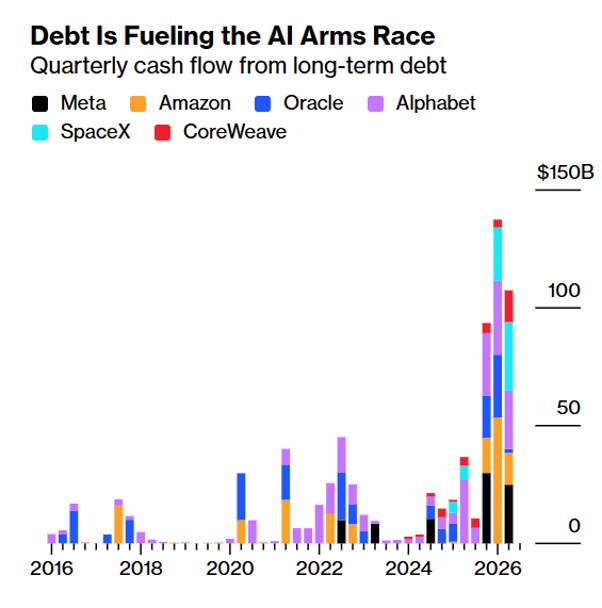
Layered on top of those headline narratives, a new one is taking shape around how the companies building AI are paying for it: debt. The chart below from Bloomberg shows how sharply borrowing has accelerated. Quarterly cash raised through long-term debt by Meta, Amazon, Oracle, Alphabet, SpaceX and CoreWeave rarely topped $40 billion before 2025. In recent quarters it has run above $100 billion. The pace has not slowed. Over the past week, Microsoft sold $25 billion of bonds, its first deal in nine years, drawing as much as $115 billion in orders. Oracle also launched a $10 billion bond sale alongside a $10 billion stock offering.
This week, voters weighed in too. Tuesday’s midterms became an unexpected referendum on AI’s physical footprint, and Texas elected a governor who campaigned on halting new data-center construction. The market’s response was revealing. Debt-funded builders sold off, while the largest tech companies rallied. Investors began betting that political limits might slow a spending race these companies have not been willing to slow on their own.
Debt on its own is neither good nor bad. It is a tool that magnifies outcomes in both directions. The more useful question is who carries the risk if the bet does not pay off, and who captures the upside if it does.
Why the Builders are Borrowing
For most of the past decade, the largest technology companies funded growth out of their own cash flow. That has changed because AI spending has grown faster than the cash these businesses generate. Alphabet made the point plainly last week. It reported negative free cash flow of about $9 billion for the third quarter, marking its second negative quarter in a row, and said capex will “increase significantly” in 2027. The stock fell more than 12% on October 29, its worst day since going public.
The buildout is being filled from outside:
- Debt. New borrowing went from 9% of capex in fiscal 2024 to 32% in the twelve months before June 2026. Aggregate debt across hyperscalers is now about $700 billion.
- Leases. Off-balance-sheet lease commitments add roughly $820 billion more, much of it for data centers.
- Equity. Alphabet priced an $84.75 billion equity raise in June 2026, including a $10 billion private placement with Berkshire Hathaway. On November 2, Oracle filed to sell $10 billion of new stock.
It’s worth keeping this in proportion. For four of the five hyperscalers, total debt is still about 1x EBITDA or less, which is conservative by most standards. Oracle is the outlier, and as a result, S&P cut it to BBB-, the lowest investment-grade rung, in July 2026.
CoreWeave: The Stress Test Playing out in Real Time
If the hyperscalers sit at the relatively conservative end of AI borrowing, CoreWeave sits at the other. The GPU cloud provider rents Nvidia-powered computing capacity to companies like Microsoft, OpenAI, Meta and Anthropic, and it has funded that buildout almost entirely with borrowed money.
In mid-October, the credit market started asking hard questions. Between October 13 and 17, CoreWeave’s stock fell about 25%, and roughly $4 billion of its bonds traded below 80 cents on the dollar, with its 2031 notes yielding about 16%. Those are levels usually associated with distressed borrowers. No single event set it off; the selloff reflected a growing doubt about whether contracted revenue can keep pace with borrowing costs. Its bonds then hit new lows after Tuesday’s elections, where candidates favoring slower data-center construction won several governor’s races, including in Texas, where CoreWeave has major sites. The 2031 notes traded as low as 79.5 cents on the dollar.
CoreWeave is not a proxy for Alphabet or Amazon, which can fund much of their spending from existing businesses (though, as Alphabet’s latest quarter shows, less of it than before). But it is a useful signal. It shows how quickly credit markets can reprice an AI borrower when profits lag, and the next two quarters of margins and interest costs will say a lot about whether the model works.
The Election: A Referendum on AI’s Footprint
The clearest signal came from Texas, which accounts for more than a quarter of planned U.S. data-center capacity through 2030. There, Democrat Gina Hinojosa unseated Governor Greg Abbott after campaigning on a statewide moratorium on new data-center construction, stricter water and power rules, and an end to the industry’s tax breaks. Voters also decided on at least 50 local data-center ballot measures nationwide.
The market’s reaction split along the same lines as the debt picture. The leveraged builders sold off, and CoreWeave’s bonds hit new lows. The hyperscalers went the other way. Amazon, Microsoft, Alphabet, Meta and Apple rallied.
Investors appear to be betting that a less friendly political backdrop could save Big Tech from itself. Tougher permitting would put a speed limit on a capex race that none of these companies have been willing to slow on their own. A slower buildout would ease the pressure to keep issuing debt to fund it, and it would make the capacity already built more valuable.
What it means for the Economy
Debt-funded investment lets the AI buildout happen faster than cash flow alone would allow, which pulls economic activity forward. Whether that is a boost or a burden depends on what the investment eventually earns.
The potential reward. Data-center construction, power generation, grid upgrades and chip manufacturing are already meaningful contributors to business investment. If AI delivers the productivity gains its proponents expect, today’s borrowing will look like the railroad, electrification or fiber buildouts at their best: expensive up front, transformative over time.
The potential risk. Those same historical examples also ended in painful overbuilds. When an investment boom is financed with debt, a slowdown does not just stop new spending. It forces lenders to absorb losses, which can tighten credit for everyone else. Heavy issuance by AI borrowers also competes with other companies for investors’ dollars, which can push up borrowing costs across the corporate bond market. And because much of the buildout runs through leases, private credit and project financing, a real share of the risk sits outside public balance sheets, where it is harder to measure.
What it means for Markets and Investors
Debt changes who wins and who loses, and by how much. Equity holders get the upside if AI pays off but take the first losses if it doesn’t. Debt holders have a capped return and a stronger claim, but they still depend on the same underlying bet.
The key distinction for any investor is where on the spectrum a holding sits. A bond from a company that can cover its interest many times over from existing businesses is a very different instrument from one whose repayment depends on AI revenue that has not yet materialized.
The Bottom Line
The rise in AI-related debt is neither a guaranteed bubble nor something to ignore. It is a sign that the AI buildout has moved from an era funded by cash to one that depends on credit markets staying open and confident.
A few things are worth watching from here:
- Free cash flow versus capex. Is the gap narrowing as AI revenue grows, or widening as spending accelerates? Alphabet’s negative free cash flow suggests it is still widening, even at the top tier.
- Credit spreads. Are investors demanding more to lend to AI borrowers, especially below the top tier?
- CoreWeave’s next two quarters. Hitting margin and interest-expense guidance would ease concerns; missing them could spread doubt to other leveraged AI names.
- Off-balance-sheet commitments. Leases and private-credit structures are a growing share of the financing and are harder to see.
- Policy risk. The latest elections brought data center permitting, power costs and local opposition into the credit picture, especially for builders that depend on a few large sites.
For investors, the practical takeaway is not to get caught up in news cycles pushing you to choose between Armageddon and Eden. It is to understand which part of the capital structure you own, how much of your portfolio depends on the same outcome, and whether you are being paid enough for the risk you are taking.