

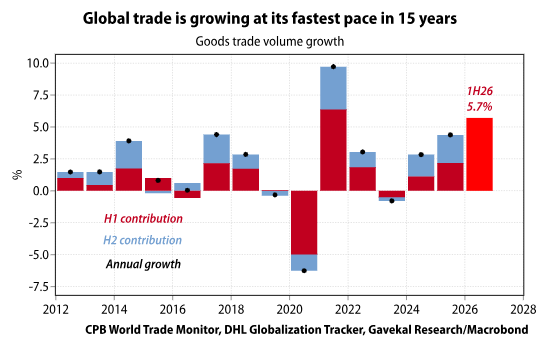
War and tariffs have knocked President Donald Trump and the Republican Party off track, but global trade continues to defy these geopolitical headwinds. This is not simply an artifact of higher prices for oil and microchips: goods trade volume is growing at its fastest pace in 15 years,1 excluding the post-Covid rebound. The expansion is driven both by strong global appetite for artificial-intelligence equipment and by exporters finding alternative markets and adapting to supply-chain disruptions.
The World Trade Organization2 forecasts that trade growth will accelerate further in 2027. The outlook is not without risks: if the AI boom turns to bust, trade growth will slow sharply in both volume and value terms. A political backlash against Chinese exports, which could reach a scarcely believable US$4.5trn in 2026, would compound the slowdown. Yet the world will struggle to break its addiction to Chinese goods, while a sustained AI investment boom would provide continued demand.
Unexpected resilience
The resilience of global trade is counterintuitive, given the disruption from Trump’s trade wars, the conflict in Ukraine and the partial closure of the Strait of Hormuz. Trade flows must also contend with Washington’s attempt to squeeze China out of politically sensitive supply chains, especially in critical minerals and advanced technologies.
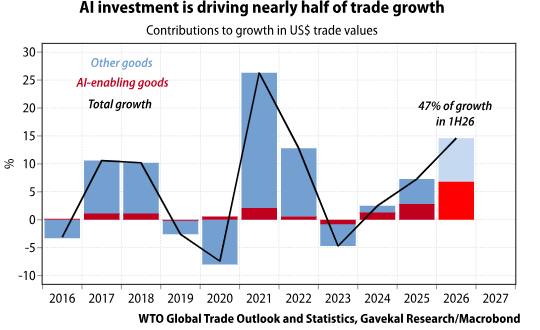
Yet tariffs and geopolitical conflict have not impaired trade as much as feared. The WTO forecasts that goods trade volumes will grow 3.9% in 2026, ticking up to 4.1% in 2027. In value terms, goods trade rose 15% year-on-year in the first half of 2026, boosted by intense demand and high unit prices for AI-related technology.
Because production relies heavily on global value chains, the AI investment boom is boosting trade in raw materials and components as well as final goods, helping to offset tariffs and other disruptions. These products accounted for about 40% of global trade growth by value in 2025 and close to half in 1H26. Total trade in AI-related goods could exceed US$6trn this year.
Beating the tariffs
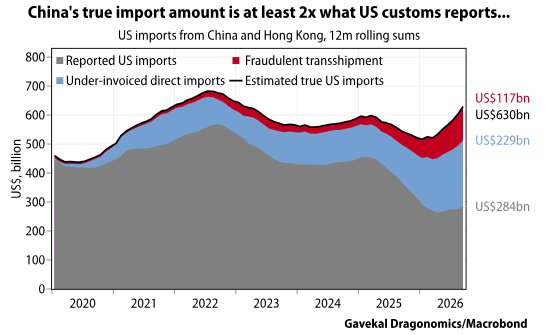
Another factor underpinning the surprising resilience of global trade is that tariffs themselves have been much less disruptive than expected. They have not prevented a rise in recorded US trade, in large part because roughly half of US imports are exempt from tariff increases. The actual value of US goods imports is higher still, because importers are systematically under-invoicing imports to avoid paying tariffs.
The bilateral trade data with China are particularly suspect. Dragonomics estimates that US companies are declaring only half the actual value of their imports from China, on which the highest tariffs are due (see chart below).
US imports from other countries also contain rising amounts of materials and components that really originate in China. Derisking and reshoring were supposed to cut China out of supply chains, but Chinese manufacturers have rerouted goods through third countries. The result is that the headline data, which show that China’s share of US imports dropped from 22% in 2017 to just 8% in 2026, massively overstate the extent of US-China decoupling. After accounting for under-invoicing and rerouting, Dragonomics estimates that China’s true share of US imports is 17% (see chart below).
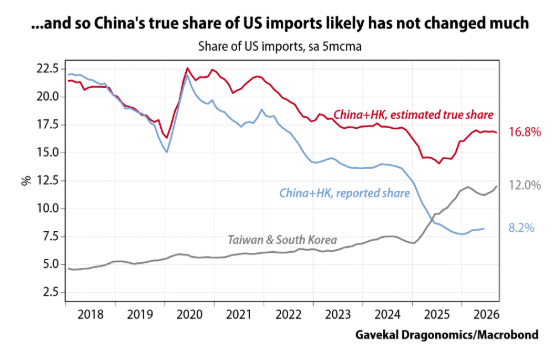
These indirect trade flows reflect the success of Chinese manufacturers in adjusting production networks and finding alternative export markets. Big winners in this reshuffling of supply chains had feared they would be struck with additional “transshipment” tariffs—yet these have yet to materialize. Vietnam is now the US’s fifth-largest trade partner, with its exports to the US surging at over 40% this year.
Global trade has been further buoyed by Washington’s close allies—the major European economies, Japan, Australia and Canada—which have largely maintained their economic ties with China, according to DHL’s analysis.3 Chinese exports to the European Union are growing at a double-digit pace and are on track to reach US$650bn this year.
The Hormuz caveat
The WTO’s forecast that trade volumes will keep rising through 2027 assumes a timely resolution to the conflict in the Middle East. This is far from certain, despite market expectations. The forecast also reflects the fact that supply chains have so far adapted better than expected to the partial blockage of the Strait of Hormuz, through which approximately 20mn bpd of oil transited before the conflict. The International Energy Agency estimates that, prior to September, 3.5-5.5mn bpd of oil were being diverted via alternative routes through Saudi Arabia’s pipeline to the Red Sea and the United Arab Emirates’ pipeline to the port of Fujairah.
Overall, the WTO estimates that exports of crude oil from the Middle East fell -24% year-on-year in the first half of 2026. But other suppliers—led by the US, Norway and Brazil—increased their production and shipments of crude oil, limiting the global decline in exports to -6%. And while the region’s exports of liquefied natural gas tumbled by -47%, global shipments of liquefied natural gas fell by just -1%, as Malaysia, Norway and Angola raised output and exports to make up for the loss.
Yet there is no certainty that alternative routes and suppliers will remain available, especially if the conflict re-escalates. September’s Houthi attacks, for example, cut off Saudi Arabia’s oil backchannel via the Red Sea. If Trump cannot find a way of ending the war and ensuring that the Strait of Hormuz fully reopens, global energy shipments could face a renewed squeeze.
Two big risks in 2027
Beyond the Middle East, there are two major risks to global trade in 2027. The first is a sharp slowdown in AI capital spending, especially in the US. This sector is highly import-intensive, so a reduction in investment would hit trade flows hard. AI goods now account for almost 15% of world trade, and their exports are highly concentrated: East Asian economies (including China) supply over half, while Southeast Asia supplies one quarter. If the AI bubble bursts, Asian tech exporters will be among the biggest casualties.
The second major risk is a broader protectionist backlash against Chinese exports. Trump’s tariffs encouraged Chinese manufacturers to redirect exports elsewhere, notably to Europe and Southeast Asia. The political tolerance for absorbing more Chinese exports is diminishing, especially in the European Union, where German industry is now pressing for much tougher collective trade defenses. Brussels is reportedly in the process of finalizing a new trade tool inspired by America’s Section 301.
Europe’s dependence on Chinese industrial inputs will, however, constrain how far Brussels can go. Keeping out Chinese-branded cars is one thing; keeping out industrial parts that European manufacturers struggle to source elsewhere is quite another. Higher tariffs and tighter controls would raise costs, disrupt production and squeeze margins—even though the US experience suggests they may not reduce Chinese imports much at all. Global trade can keep defying politics in 2027, but the companies conducting it may face an even tougher year.
- https://www.dhl.com/global-en/microsites/core/global-connectedness/tracker.html
- https://www.wto.org/english/res_e/booksp_e/gtos1026_e.pdf
- https://www.dhl.com/global-en/microsites/core/global-connectedness/tracker.html
DISCLOSURE: This material has been prepared or is distributed solely for informational purposes only and is not a solicitation or an offer to buy any security or instrument or to participate in any trading strategy. Any opinions, recommendations, and assumptions included in this presentation are based upon current market conditions, reflect our judgment as of the date of this presentation, and are subject to change. Past performance is no guarantee of future results. All investments involve risk including the loss of principal. All material presented is compiled from sources believed to be reliable, but accuracy cannot be guaranteed and Evergreen makes no representation as to its accuracy or completeness. Securities highlighted or discussed in this communication are mentioned for illustrative purposes only and are not a recommendation for these securities. Evergreen actively manages client portfolios and securities discussed in this communication may or may not be held in such portfolios at any given time.