


A quick glance at financial markets would seem to indicate that everyone has taken a month off to watch the football World Cup. The DXY index is essentially at the same level as in mid-June (or late March). The S&P 500 and SOX indices are at roughly the same levels as in mid-to-late May. Long-dated bonds are essentially back to the lows of mid-May. And oil prices are back to US$85/bbl, where they stood in mid-June. Meanwhile, gold has been hovering around US$4,100/oz since mid-June. Even bitcoin, that most volatile of assets, has spent the past four weeks doing essentially nothing.
In short, after a number of tumultuous months, it seems that financial markets have decided to take a breather. Meanwhile, a number of important events have occurred in recent days, which mean that this past month of stability is unlikely to last. Specifically:
- The Japanese finance minister signaled growing dissatisfaction with the falling yen,and encouraged Japanese pension funds to start bringing money home. The market seems to be fading this new policy direction from the Japanese finance ministry. But this still seems like a possibly important policy shift. At the very least, it makes shorting the yen and Japanese government bonds less of a one-way bet?
- The odds that the US Federal Reserve will raise rates this year have to be lengthening. First, new Fed chair Kevin Warsh announced not one, but five, committees to review the Fed’s processes, each staffed with the great and the good of central banking (Mervyn King, Arminio Fraga, Raghuram Rajan), academia (Jeremy Stein, Thomas Sargent, Charles Jones) and tech (Marc Andreessen, Asha Sharma). A perfect cover, if ever there was one, for the Fed to sit on its hands for months and months to come. After all, why act before the committees reveal their findings?
Secondly, and very fortunately, the latest US CPI numbers surprised on the downside, which gives the Fed more room to sit on its hands and “wait for the findings of the committees.” - The tensions in the Middle East have flared up again, with the Strait of Hormuz seemingly closed once again. Although of course by this stage, investors are all worried about being wrong-footed by the next social media post announcing the return of peace, and so positioning on energy remains minimal.
- Meanwhile, crack spreads continue to grind higher. Possibly this is because, with the Strait closed, a shortage of products (especially diesel) is a real threat.
But most likely it is because Russia and Ukraine continue—very successfully—to target each other’s refineries. In recent months, Ukraine has managed to damage all 10 of Russia’s top refineries. This is a problem for Russia. But it is also possibly a problem for the rest of the world, since as a result of the Ukrainian attacks, on July 8 Russia decided to ban all exports of diesel and gasoline. - The Kospi is now down -25% from its mid-June high, with stories of tens of thousands of margined Korean retail investors being wiped out. Of course, the market was very extended after impressive gains. But behind the roll-over lies the question of how sustainable the boom in memory demand and the firmness of chip prices will prove to be.
- Staying on chips, CXMT is set to go public at RMB8.66 a share. To be honest, the fact that the issue price is not RMB8.88 is a bit of a surprise. Three eights would have been far more auspicious. But either way, this is a landmark deal which signals that China fully intends to be a long-term player in the global memory space.
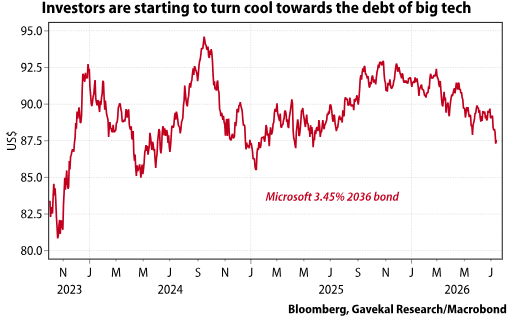
- The debt of US big tech has started to sell off. It seems bond investors are starting to dislike open-ended plans for ever-more AI-related capital expenditures. Or to put it another way, while a few years ago the cost of capital for big tech was essentially zero, this is clearly no longer the case. The chart below shows the price of the Microsoft 2036 bond. Not a disaster by any stretch. But then Microsoft has far fewer clouds hanging over it than Oracle or IBM or Salesforce. And so with the cost of capital rising, the question becomes: how committed will the hyperscalers remain to ever-larger capex expansions?
8. The debt of SpaceX has sold off meaningfully since issuance. And the company’s shares are basically back at their IPO price—and this is before the first share lock-ups expire in August. Not a great harbinger of things to come?
At the very least, a bond that falls by -0.5% a day, almost like clockwork, shortly after the company raised a record amount of equity from the financial markets, is truly not an exciting development.
By itself, any one of these developments would seem to be important. After all, the first development should be bullish yen. The second is bearish the US dollar. The third is bullish commodities. The fourth is bearish for the low-end global consumer, and announces higher inflation. And the fifth, sixth, seventh and eighth are all, to some measure, bearish tech. But taken all together, it does seem likely that these various developments announce a different world than the one markets have lately been pricing?
DISCLOSURE: This material has been prepared or is distributed solely for informational purposes only and is not a solicitation or an offer to buy any security or instrument or to participate in any trading strategy. Any opinions, recommendations, and assumptions included in this presentation are based upon current market conditions, reflect our judgment as of the date of this presentation, and are subject to change. Past performance is no guarantee of future results. All investments involve risk including the loss of principal. All material presented is compiled from sources believed to be reliable, but accuracy cannot be guaranteed and Evergreen makes no representation as to its accuracy or completeness. Securities highlighted or discussed in this communication are mentioned for illustrative purposes only and are not a recommendation for these securities. Evergreen actively manages client portfolios and securities discussed in this communication may or may not be held in such portfolios at any given time.