


The artificial intelligence investment boom came under renewed threat Saturday when Anthropic’s chief executive argued that his company and others should “slow the pace” of AI model development to ensure safe deployment, a call quickly endorsed by the leaders of two other frontier labs, OpenAI and xAI. Given that these companies are among the most intensive consumers of compute on the planet, the comments naturally raised concerns about the outlook for AI capital spending.
At the same time, there is growing grassroots pressure to regulate the pace of data center deployment, which both Republicans and Democrats are scrambling to address. Long-term bond yields have also climbed quickly, with 10-year treasury yields moving above 5% for the first time since 2007. To top it off, the Federal Reserve hiked policy rates on Wednesday for the first time since 2023, putting further upward pressure on the real cost of capital across the yield curve.
These are all potential threats to the AI capex boom. But how likely is each to seriously throttle investment? Consider them in turn:
- Altruistic self-regulation of pace. Not going to happen, at least not much beyond what is already taking place. Frontier labs already self-regulate to some extent. Consumer demand for capable, reliable and safe AI models, along with concerns about legal liability, forces them to test models before deployment. Recent mishaps suggest there is room for improvement, and Anthropic’s Dario Amodei argues that this can only come at the expense of pace. Perhaps. But do not expect a material slowdown in development or demand for compute. If any frontier lab does slow down, competitors will close the gap, forcing it to pick up the pace or risk being overtaken. Nvidia’s Jensen Huang certainly sees no reason to slow down, and his company produces not only chips but also one of the leading open-source models in the US. And then there are Chinese. Whatever Amodei, Altman and Musk do, someone will be pushing the frontier as fast as they can.
- US government regulation to slow the pace. Not going to happen, at least not across the country. Remember when everyone was worried that political backlash to fracking would put an end to that revolution in oil production? It did not, and the same is likely to be true of data center development. To be sure, rapid deployment and the resulting power demands have generated political opposition, leading to high-profile state moratoriums in New York and Texas and numerous local restrictions. But these are more likely to be a nuisance than a boom killer. Data center builders can wait out moratoriums, shift to “behind-the-meter” power solutions or move to other jurisdictions. SemiAnalysis estimates that existing state and local restrictions will delay about 2.3 GW of planned US capacity. That is significant, but it still projects 38 GW of additions in 2027, up from 18 GW in 2026 and 10 GW in 2025.
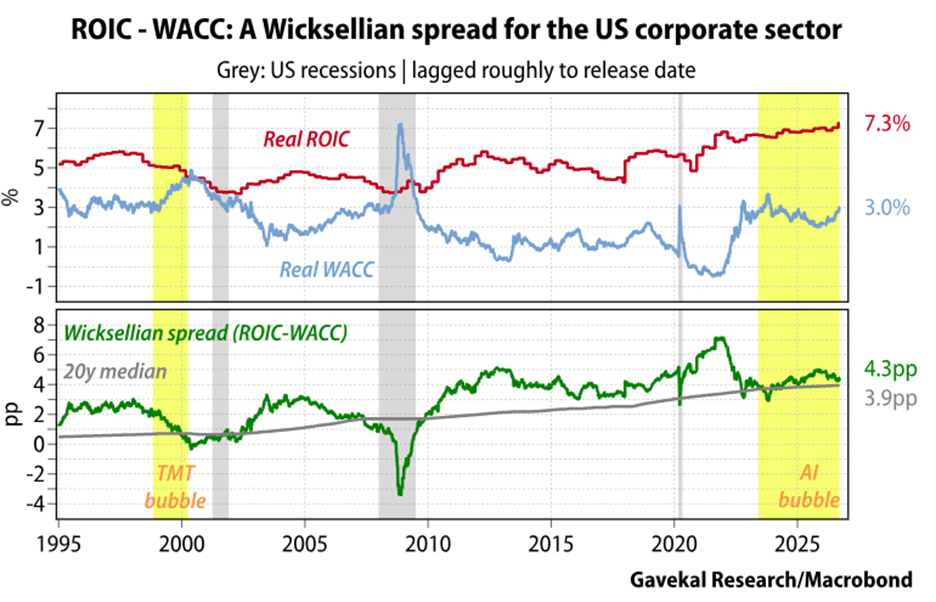
Restrictive federal regulation could seriously hamper the capex boom, but President Donald Trump has made clear he wants investment and US leadership in AI, particularly relative to China. He is therefore unlikely to support legislation that threatens either goal. On Wednesday, the House voted 417-3 to pass the Ratepayer Protection Act, but the bill merely asks states to consider making data centers cover the cost of new power generation and transmission upgrades. Being voluntary, it is likely to have about as much impact on data center construction as Amodei’s call for a voluntary slowdown in model development. - Demand for compute and returns both fall. This could happen someday, but there is little sign of it yet. Instead, all indications point to insatiable demand for compute. AI companies throughout the supply chain continue to post solid earnings, while the corporate-sector-wide return on investment in the US reached a record high last quarter. So far, returns show no sign of buckling under the weight of heavy AI investment, quite unlike the telecom boom of the late 1990s.
- Supply bottlenecks. These have been a feature of the AI investment boom, first in advanced processors, then power and now memory. But the market has done its job, bidding up prices where supply is scarce and spurring a supply response that keeps the boom moving forward. It has been more a game of whack-a-mole than a brick wall.
- Rising cost of capital. This was already the biggest threat to the AI infrastructure boom, and monetary tightening from the Fed only adds to the pressure. As such, it deserves particular attention today.
Real yields have been rising amid heavy capital raising by AI companies and government borrowing to fund growing entitlements and costly wars. US Treasury Secretary Scott Bessent is trying to counter these forces with buybacks at the long end of the treasury curve, but so far his purchases have disappointed in scale.
Rate hikes only add to the upward pressure on real yields. As expected, the Fed hiked 25bp on Wednesday, with Warsh promising to do whatever it takes to return inflation to target, defying recent calls from the president to cut
This had the desired effect of weighing on inflation expectations (breakeven inflation on 10-year TIPS fell -5bp), but it predictably pushed real yields higher (10-year TIPS yields rose 6bp). The net effect on nominal yields was marginal, but the fact remains that monetary policy tightening is now adding to the upward pressure on the real cost of capital.
It is hard to say exactly what cost of capital will significantly slow investment, in AI or elsewhere, but the “Wicksellian spread” offers a guide. Whenever the spread between the real return on invested capital in the US corporate sector and the real cost of capital falls below its 20-year median, the probability of a generalized investment slowdown rises significantly. The spread has yet to cross this threshold, suggesting that short rates and bond yields can move somewhat higher before seriously dampening capital spending growth (see chart above). That is good news for equities and bad news for bonds. Still, the indicator is imprecise and the spread is getting uncomfortably close to the threshold. Any further rise in real financing costs will therefore increase the risk of slowing the AI boom in a way that no blog post from Dario Amodei can.
Bond yields may not yet be high enough to justify overweighting bonds and underweighting equities. But they are high enough to justify adding some bonds as a hedge against the risk that something—most likely the high cost of capital—unexpectedly kills the AI investment boom. When that eventually happens, it should be bullish for bonds because weaker AI investment would remove a major source of private demand for capital and have negative ripple effects across the economy and markets, as recently argued by Anatole.
Bonds could also serve as a hedge for human extinction, as that would be quite the deflationary event. And if one is wrong about that, who is going to complain?
DISCLOSURE: This material has been prepared or is distributed solely for informational purposes only and is not a solicitation or an offer to buy any security or instrument or to participate in any trading strategy. Any opinions, recommendations, and assumptions included in this presentation are based upon current market conditions, reflect our judgment as of the date of this presentation, and are subject to change. Past performance is no guarantee of future results. All investments involve risk including the loss of principal. All material presented is compiled from sources believed to be reliable, but accuracy cannot be guaranteed and Evergreen makes no representation as to its accuracy or completeness. Securities highlighted or discussed in this communication are mentioned for illustrative purposes only and are not a recommendation for these securities. Evergreen actively manages client portfolios and securities discussed in this communication may or may not be held in such portfolios at any given time.
About the Author