
The big US tech companies, including Amazon, Meta and Alphabet, have long commanded investors’ attention. For years, their business model of rapid innovation, low capital expenditure and strong cash flows allowed their share prices to perform well almost regardless of the investment climate—generating a succession of catchy investment themes, first as platform companies, next as FAANGs, then as the Magnificent Seven.
Now, that business model—and the investment narrative—has changed. No longer the Mag-7, they have become hyperscalers; and in the race to secure AI dominance they are investing capital at breakneck pace in the necessary AI chips, data centers and supporting infrastructure. As a result, their free cash flows are dwindling (see the chart below). From here, the relative trajectories of their capex and free cash flow will shape their businesses and determine the performance of their share prices. There are four main scenarios to consider.
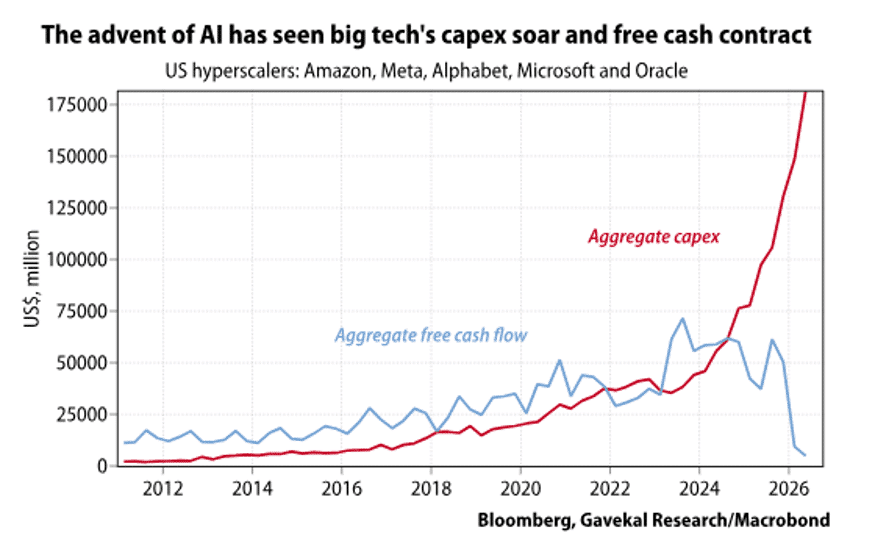
1. The hyperscalers continue to spend heavily on capex, and their free cash flows shrink further. This is a continuation of the current trajectory. In this scenario, the companies remain optimistic about the demand for AI compute, even though their free cash flows continue to deteriorate in the near term. The consensus as of 27 July 2026, compiled by Apollo’s Chief Economist Torsten Sløk, shows that the US hyperscalers’ capex is expected to rise strongly, and their free cash flows are expected to decline through 2027. Given the market’s recent track record of underestimating AI capex spend, this consensus could be revised to become even more pronounced.
In this scenario, the US hyperscalers become long-duration stocks. Because their cash flows are realized further in the future, long-duration stocks are more sensitive to real yields. And because of the hyperscalers’ growing reliance on debt financing, concerns around credit conditions will grow. But for now, the widening of CDS and credit spreads for the hyperscalers is not alarming (except for Oracle).
The key risk for long-duration stocks is rising real yields. Higher real yields will likely hurt neocloud stocks such as CoreWeave and Nebius more than hyperscalers such as Amazon, Alphabet, Meta and Microsoft, which have other profitable businesses. However, the hyperscalers will be hurt more than shorter-duration stocks such as banks and energy plays.
2. The hyperscalers continue to spend heavily on capex, and their free cash flows start to rise. In this scenario, the business model of selling AI compute proves sustainably profitable. However, the hyperscalers may need to continue to invest heavily either because (i) the strength of demand for AI compute means the capex upcycle lasts longer than expected, or because (ii) the chips and other hardware powering AI compute rapidly become obsolete, and require frequent replacement.
In this scenario, the US hyperscalers transform from asset-light, software-focused businesses with low fixed costs to asset-heavy, technology-infrastructure companies with high fixed cost bases. This will leave the hyperscalers hostage to the degree of cyclicality in demand for AI compute. If demand for AI compute is stable, the asset-heavy business model means the hyperscalers will operate like utility companies. However, if the demand for AI compute proves cyclical, the US hyperscalers’ profitability will become more erratic, much like the profitability of miners or energy companies.
3. The hyperscalers scale back their capex, and their free cash flows rise. After a period of elevated investment, the hyperscalers reach their optimal capacity to meet demand for AI compute. In this scenario, the completed capacity starts to generate healthy cash flows, but its value depreciates only relatively slowly, allowing the hyperscalers to scale back their capex. For the hyperscalers, this is the ideal scenario. Lower capex and higher cash flows allow them to repay debt and buy back shares. Over time, the hyperscalers’ financial positions will return to something resembling their pre-AI luster.
4. The hyperscalers scale back their capex, but their free cash flows do not improve. In this scenario, investment in AI data centers fails to generate sustainable cash flows, and either the hyperscalers voluntarily cut capex, or their sources of capital dry up. This may happen because AI turns out to be less productivity-enhancing than hoped, or because overbuilding leads to an oversupply of AI compute, or because Chinese competition squeezes profits, or because technological breakthroughs in quantum computing render AI compute obsolete.
The timing of this scenario will be crucial. If it happens in the near term when the debt-to-equity ratios of most hyperscalers (excluding Meta and Oracle) are still roughly in line with the S&P 500 average (even taking into account off-balance-sheet financing) and their cash-to-asset ratios are still healthy, strong cash flows from the hyperscalers’ other businesses will tide them over. However, if it happens when the hyperscalers have already become highly leveraged, there will be a risk of bankruptcies. CDS and credit spreads will likely blow out. And the share prices of the hyperscalers and their creditors will likely collapse.
According to their latest capex guidance, the US hyperscalers will continue to invest heavily over the coming year. Borrowing costs are not high enough to discourage capex, and capital remains readily available, as the US$500bn package announced earlier in August by Nvidia demonstrates. This suggests that in the near term, the probabilities of the first and second scenarios are higher than the probabilities of the third and fourth. However, there remains a big question mark over just when the hyperscalers’ capex will begin to generate healthy and sustainable free cash flows. If they can begin to generate rising free cash flows soon, their stock prices will benefit. But the longer it takes, the more the hyperscalers will face a choice: either cut AI investment and focus on balance sheet recovery, or double down on their capex and run a greater risk of bankruptcy down the road.
Written by Tan Kai Xian – Gavekal Research
DISCLOSURE: This material has been prepared or is distributed solely for informational purposes only and is not a solicitation or an offer to buy any security or instrument or to participate in any trading strategy. Any opinions, recommendations, and assumptions included in this presentation are based upon current market conditions, reflect our judgment as of the date of this presentation, and are subject to change. Past performance is no guarantee of future results. All investments involve risk including the loss of principal. All material presented is compiled from sources believed to be reliable, but accuracy cannot be guaranteed and Evergreen makes no representation as to its accuracy or completeness. Securities highlighted or discussed in this communication are mentioned for illustrative purposes only and are not a recommendation for these securities. Evergreen actively manages client portfolios and securities discussed in this communication may or may not be held in such portfolios at any given time.
About the Author