

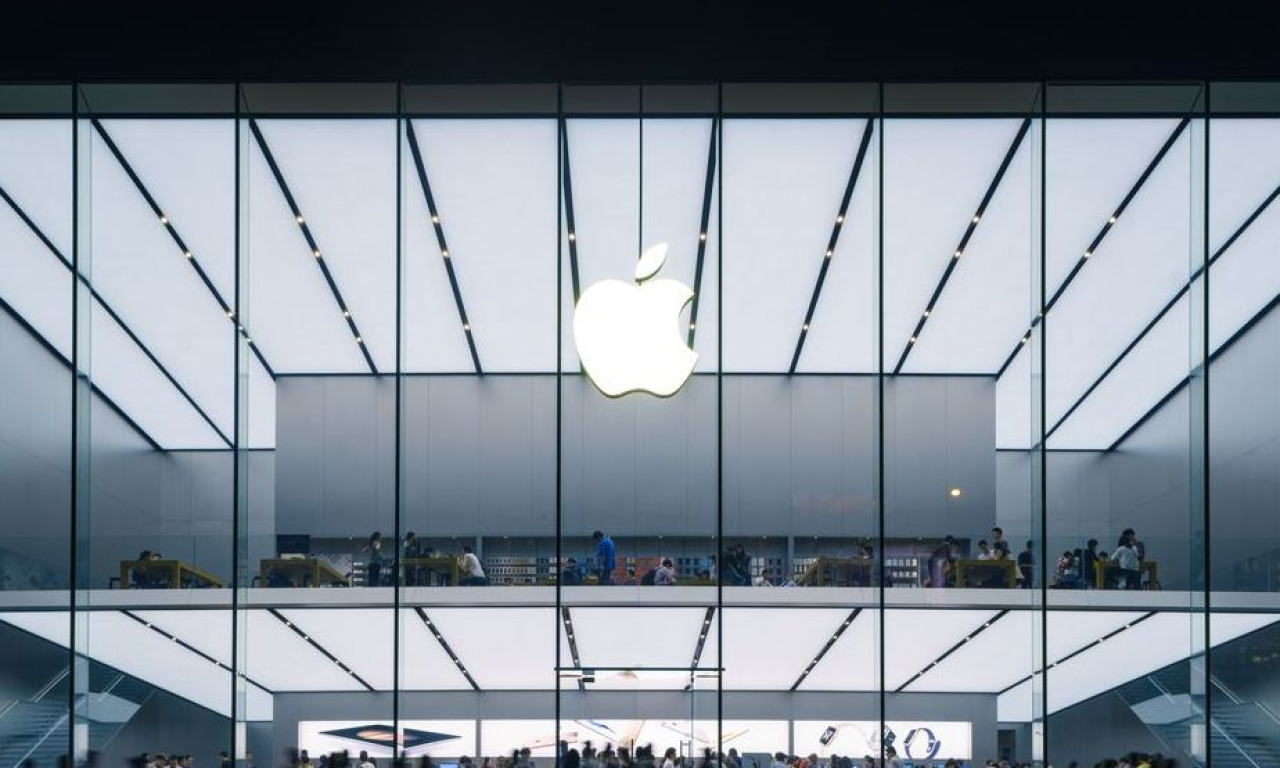
Apple has arguably produced the most consequential consumer technology since the turn of the millennium. It’s hard to understate how quickly the world changed after the iPhone launched in 2007. Ever since, the world has looked at Apple events as a signal for how hardware and software are evolving and where technology is heading next.
For many tech enthusiasts, Apple’s four main event windows each year remain a staple:
· A spring event
· Worldwide Developer Conference (WWDC) in June
· The iPhone event in September
· Sometimes another event in October
This week’s iPhone event unveiled Apple’s first foldable phone, the iPhone Duo, which is the most significant iPhone design update since the original iPhone launched. However, Apple is not a pioneer in foldable phone technology and is in fact far from it. The first commercially available foldable smartphone with an OLED display was the Royole FlexPai, which launched in November 2018. Samsung and Huawei also launched foldable phones many years ahead of Apple.
Which begs the question: Are Apple events still the clearest signal of where technology is heading next?
Apple’s Case: Refinement Still Matters
Apple’s strongest case has never rested simply on being first. It rests on making hardware, software, and services work together in ways people find useful—and want to keep using.
The iPhone Duo is a new test of that proposition. It combines a 7.6-inch inner display, a 5.4-inch outer screen, and an under-display camera. Starting at $1,999 and scheduled to become available on October 23, it is unmistakably a premium device.
The question is not whether Apple invented the foldable phone. It is whether Apple can make the format more compelling for people who have not yet seen a reason to switch. That judgment will depend on everyday usability, durability, and software—not the keynote alone.
Satellite connectivity offers a useful example of Apple’s approach. Emergency SOS via satellite arrived with the iPhone 14 in 2022, followed by roadside assistance in 2023. Messages via satellite followed in 2024, and satellite connectivity reached Apple Watch Ultra 3 in 2025.
The significance lies in turning a specialized capability into services accessible through familiar devices. It is not necessarily a new category of technology, but it can still change what people expect their technology to do.
This year’s Watch and Health announcements follow a similar pattern. Live Rewind promises to transcribe the previous 15 seconds of conversation, while Siri Recap offers opt-in conversation summaries; both are scheduled for beta availability later in 2026. Sound Recognition provides alerts for important environmental sounds. A Readiness score and the forthcoming Health Age metric extend Apple’s health ambitions, with the redesigned Health app also due later this year.
These are not necessarily category-defining inventions. But refinement is not the opposite of innovation. Making technology easier to use, more accessible, or more relevant to everyday life can matter as much as introducing it first.
The Companies Competing to Define What Comes Next
Where Apple faces a different kind of competition is in setting the agenda.
Challengers are not all selling direct substitutes for an iPhone. Some are building infrastructure; others are pursuing robots or new ways of interacting with AI. What they share is an attempt to define the next chapter of computing.
Tesla’s humanoid robots. Tesla has turned Optimus into arguably the most-watched hardware story outside of Cupertino. At the AWE 2026 expo in Shanghai, Tesla showed off Optimus’s hands in close detail — finger proportions and joint structures built to mimic human anatomy, a nod to how difficult dexterous manipulation is to solve in robotics. Tesla’s Fremont facility is targeting one million units a year and Gigafactory Texas is being built for 10 million. Elon Musk has described the ambition in typically maximalist terms, calling Optimus “the first Von Neumann machine, capable of building civilization by itself on any viable planet.” Whether or not that timeline or ambition holds, Tesla has successfully made its product roadmap — not just its car launches — into appointment viewing.
Nvidia’s keynotes. Jensen Huang’s CES and GTC keynotes have become the closest thing the industry has to Apple events, except the product isn’t a phone — it’s the infrastructure the entire AI industry runs on. GTC 2026 drew global tech leaders to hear Huang detail Nvidia’s Blackwell and Vera Rubin chip platforms, framing Nvidia’s roadmap as the pacing mechanism for the entire AI economy.
Meta’s smart glasses. Meta has spent the past two years turning Ray-Ban Meta glasses from a novelty into a real hardware category, and Meta Connect 2026 is expected to push further with new models rumored to include always-on displays. Meta’s bet is that glasses, not phones, become the next default computing surface — and unlike Apple’s Vision Pro, Meta’s version is cheap, light, and already selling in the millions.
OpenAI’s hardware ambitions. Perhaps the most direct threat to Apple of all: OpenAI has confirmed it’s working on its first consumer hardware device with former Apple design chief Jony Ive. Reporting suggests a screenless, context-aware device that leans entirely on AI rather than an app grid. It’s a direct bet that the next iPhone-scale moment won’t come from Apple at all, but from the person who helped design the iPhone in the first place.
So, Is Apple Still the Signal?
The answer depends on what you are measuring.
As a cultural event, an Apple launch still matters. The iPhone Duo is newsworthy because it changes a familiar product, not because Apple arrived first. A technology can gain new significance when it reaches a different audience or fits into an ecosystem people already use.
But as a guide to where computing goes next, Apple is no longer the only place to look. AI infrastructure, humanoid robotics, smart glasses, and AI-first devices offer competing visions of the future—and different levels of evidence that those visions will work.
For Apple’s new CEO, John Ternus, the challenge is not simply to choose between refinement and invention. It’s to show that Apple can still turn emerging capabilities into products that change what people expect from technology.
So yes, Apple events are still headline news. However, they are no longer the only headlines that matter.
DISCLOSURE: This material has been prepared or is distributed solely for informational purposes only and is not a solicitation or an offer to buy any security or instrument or to participate in any trading strategy. Any opinions, recommendations, and assumptions included in this presentation are based upon current market conditions, reflect our judgment as of the date of this presentation, and are subject to change. Past performance is no guarantee of future results. All investments involve risk including the loss of principal. All material presented is compiled from sources believed to be reliable, but accuracy cannot be guaranteed and Evergreen makes no representation as to its accuracy or completeness. Securities highlighted or discussed in this communication are mentioned for illustrative purposes only and are not a recommendation for these securities. Evergreen actively manages client portfolios and securities discussed in this communication may or may not be held in such portfolios at any given time.
About the Author

Michael Johnston Tech Contributor
Michael Johnston serves as a Technology Advisor and Columnist at Evergreen Gavekal, bringing deep industry insight through his role as Co-Founder and Chief Business Officer at TEAL, a high-growth, venture-backed Network Infrastructure company based in Kirkland, Washington.
More Posts by Michael Johnston
The Private Markets J-Curve Is Changing
For decades, investing in private markets required investors to accept a fundamental tradeoff: in exchange for the potential for attractive…
Billion-Dollar Rounds Are Surging. Is That a Good Thing?
Ten-figure financings may be a rational response to the capital needs of AI, energy, space, and advanced manufacturing companies. However,…

5 Observations on the Job Market
Data on the health of the job market is one of the most important inputs for understanding the economy. It…