

In the week ending March 6, crude markets experienced their sharpest move in history, gaining 35.63% for the week. Brent rose roughly 27%, marking its largest weekly advances since spring 2020 as the conflict involving Iran disrupted production, shipping, and refinery operations across the Middle East. The move reflected not only immediate supply concerns, but also a broader repricing of geopolitical risk across the global energy complex.
That sensitivity is understandable. According to the U.S. Energy Information Administration (EIA), roughly 20 million barrels per day moved through the Strait of Hormuz in 2024, equal to about 20% of global petroleum liquids consumption. When that route appears vulnerable, oil begins to reflect more than just current supply and demand. It starts to price in the possibility of tighter global balances, higher transport costs, and broader economic effects.
In overnight trading heading into Monday, March 9, WTI briefly touched $119.48 per barrel, its highest intraday level since June 2022, before pulling back sharply. Even so, Monday’s official settlement still showed meaningful stress, with WTI closing at $94.77 and Brent at $98.96. The reversal continued on Tuesday after President Donald Trump signaled the conflict could end sooner than markets had feared. By Tuesday’s close, WTI had fallen to $83.45 and Brent to $87.80, highlighting just how quickly geopolitical headlines are flowing through to price action.
For investors, the implications reach well beyond energy. Oil is a key input for transportation, manufacturing, and consumer fuel costs, so a sustained rise in prices can lift headline inflation, weigh on consumer sentiment, and complicate the Federal Reserve’s policy path. Earlier this month, traders scaled back expectations for Fed rate cuts as energy prices moved higher, even as Fed Governor Christopher Waller noted that a short-lived oil shock would be unlikely to create persistent inflation.
The central question now is not whether a geopolitical premium belongs in oil prices, but how long it may remain in place. If shipping disruptions ease and output returns quickly, a meaningful share of the recent move could unwind. Even in a de-escalation scenario, however, supply normalization may take time. Production can be shut down quickly, but restarting wells, refinery throughput, port activity, and tanker schedules can take time.
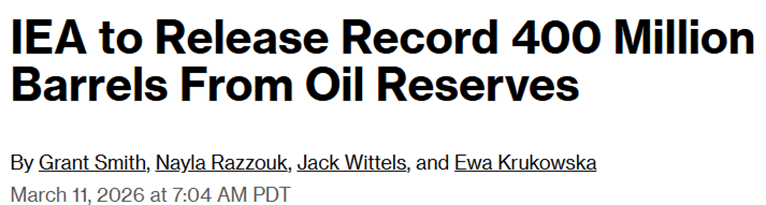
In the days ahead, markets are likely to stay focused on three key variables: the reliability of commercial transit through the Strait of Hormuz, the pace at which Gulf producers restore output and refining capacity, and the willingness of policymakers to use tools such as strategic reserve releases or sanctions adjustments to help stabilize supply. On that front, the International Energy Agency (IEA) has already agreed to release 400 million barrels from reserves to contain further price spikes, marking its largest-ever release.
The broader takeaway is that this episode is about more than a short-term headline spike. It is also a reminder that crude oil remains one of the clearest channels through which geopolitical shocks can influence inflation expectations, central-bank thinking, and cross-asset risk sentiment. For now, some elevated volatility is likely to remain part of the landscape until there is greater clarity on the trajectory of the conflict and the operational status of the Strait of Hormuz.
That said, market outlook could improve quickly if tensions ease. A durable end to the conflict - or a meaningful political shift that lowers long-term regional risk - could allow a sizable geopolitical premium to come out of crude prices. In that scenario, oil markets could gradually move back toward a more stable footing, helping support broader risk assets, improving visibility for central banks, and creating the conditions for a wider rally across global markets.
DISCLOSURE: This material has been prepared or is distributed solely for informational purposes only and is not a solicitation or an offer to buy any security or instrument or to participate in any trading strategy. Any opinions, recommendations, and assumptions included in this presentation are based upon current market conditions, reflect our judgment as of the date of this presentation, and are subject to change. Past performance is no guarantee of future results. All investments involve risk including the loss of principal. All material presented is compiled from sources believed to be reliable, but accuracy cannot be guaranteed and Evergreen makes no representation as to its accuracy or completeness. Securities highlighted or discussed in this communication are mentioned for illustrative purposes only and are not a recommendation for these securities. Evergreen actively manages client portfolios and securities discussed in this communication may or may not be held in such portfolios at any given time.